Year Structure
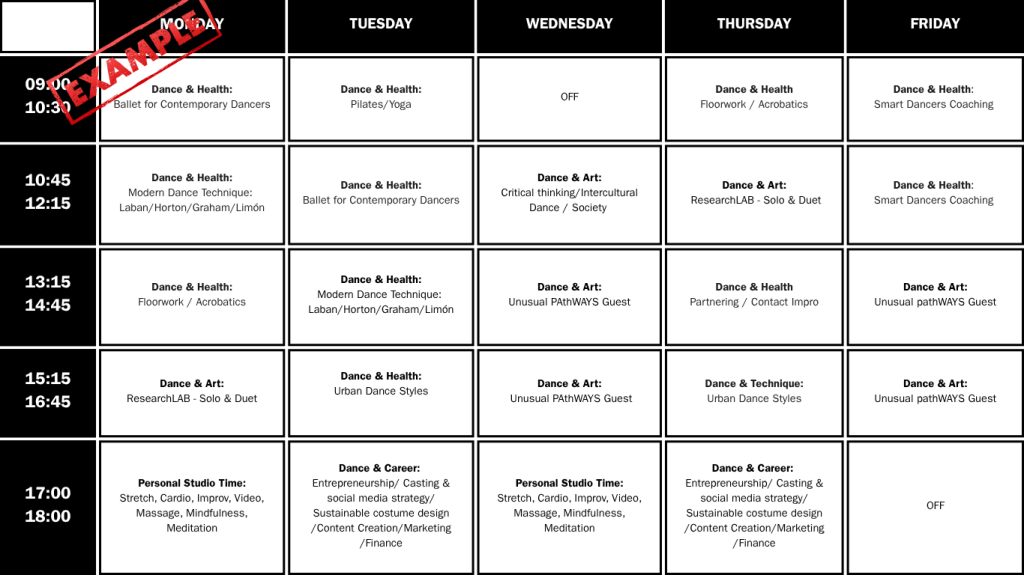
The WAYS academic year follows the rhythm of a higher education program. It begins at the end of September and concludes in mid-June. The year is divided into three trimesters. The first trimester runs until the Christmas holiday period. The second trimester continues until the Easter holiday period. The third trimester concludes in mid-June and culminates in the End of the Year Performance, a keystone of WAYS’S dance Method. This structure allows students to build skills progressively while maintaining focus on long-term growth to face today’s dance industry.
Milestones
Each trimester includes a clear milestone that marks the progress of the student. These moments help students to learn how to self-reflect and prepare for the expectations of professional dance career.
The first and the second trimester end with Christmas and Easter Exams. The exams simulate an audition experience and focus on the performance at that specific moment in time, rather than on long-term progression, which is addressed through the permanent evaluation throughout the year. These assessments evaluate technical progress, artistic development and professional attitude. During the first two trimesters, students receive intensive contemporary dance training that prepares them physically and artistically for the final phase of the year. They strengthen technique, refine artistic skills and develop the discipline required in the dance industry.
The third trimester shifts the focus from preparation to application. Students begin to use the knowledge and tools they have developed, translating training into rehearsal processes, creative work and stage performance.
During the third trimester adopts the working rhythm of a professional dance company. The daily structure reflects the realities of the field and introduces students to the expectations of professional rehearsal processes. Each day begins with a warm-up session that supports physical readiness and injury prevention. After the morning training, students enter creative processes led by choreographers who are actively working in the contemporary dance field. At the same time also expanding their network. Over a period of 2 months, students collaborate closely with these choreographers and participate in the full trajectory of a professional creation process. They learn to manage rehearsal schedules, respond to artistic direction and contribute to collective work. This period culminates in a public end-of-year performance, where students present their work to an audience and experience the responsibility and discipline required in a professional production context.
Evaluation and Feedback
Evaluation plays a constructive role throughout the academic year. Rather than focusing solely on numeric results, the program emphasizes on progress. Midway through each trimester, students receive a permanent evaluation. Teachers provide written feedback and use colour indicators to communicate progress in a clear way. These moments allow students to identify strengths, address challenges and adjust their training accordingly. After the exams at the end of the trimester, teachers meet personally with the students to discuss results in depth. These conversations offer nuance, context and practical guidance, ensuring that the evaluation supports growth rather than being a judgment.
Testimonials WAYS-Alumni
Sarah H.
“TBC”
JADE A.
“TBC”
LUNA S.
“TBC”
Fantine L.
“TBC”
 WAYS
WAYS 